Loosen and re-tighten strategy
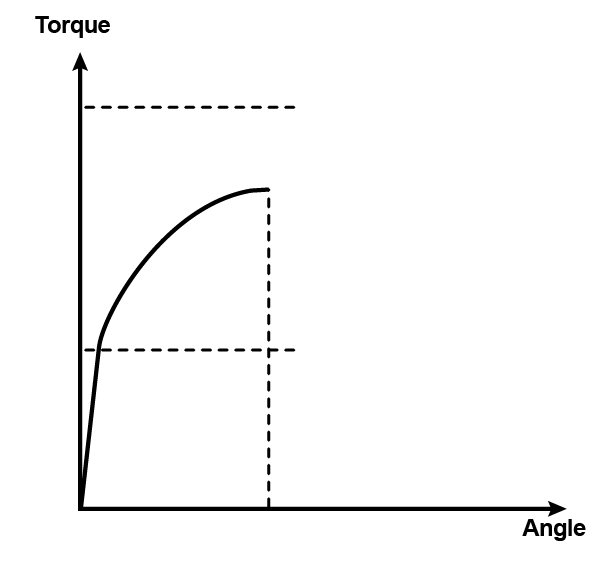
This strategy checks the residual torque on the joint. It uses a loosen-and-tighten method to identify the residual point on the torque-versus-time trace.
Parameter | Description |
|---|---|
Inspection Name | Name of the inspection. |
Cycle start | Torque value from which the test operation starts. |
Minimum torque | Lower torque limit value. |
Maximum torque | Upper torque limit value. |
Change screw | If the torque applied reaches this limit, the message Change screw is shown on the wrench display. The Change screw must be ≥ Maximum torque. |
Target torque | Torque target value. |
Torque tolerance | Torque tolerance that defines the maximum torque and the minimum torque according to the Target torque previously specified. Value is expressed in percentage (%). |
Control mode | Method to define the torque limits from the following options:
|
Target angle | Loosening target angle |
Torque correction coefficient | When extensions are used, the wrench measurement must be compensated to show a more accurate torque value. To calculate the correction coefficient, please refer to How to calculate the Torque Correction Coefficient. When extensions are not used, Torque correction coefficient = 1. |
Angle correction coefficient | When extensions cause additional wrench bending, the wrench angle measurement must be compensated to show a more accurate angle value. When extensions are not used, Angle correction coefficient = 0. |
Number of sample | Number of tests to run inside the inspection. |
The residual torque is the torque measured at the end of the re-tightening operation, at the target angle. The target angle is usually set to a few degrees. If the angle is set too high, the torque during the loosening phase may drop below the cycle start value. In that case, the angle measurement will stop, and the test cannot continue.
|
|
Loosening | Re-tightening |