Product information
General information

Symbols on the tool
The symbols on the tool have the following meanings:
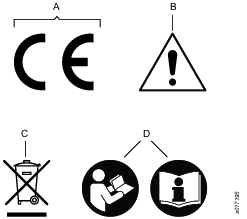
A | Directive 2006/42/EC on Machinery specifies the essential health and safety requirements the product has to meet in order for the manufacturer to affix the CE marking. |
B | When operating the device be sure to use caution. |
C | The symbol indicates that parts within the product must be handled in accordance with the WEEE Directive. |
D | Read the instruction manual/booklet before starting work or before operating equipment or machinery. |
Safety signal words
The safety signal words Danger, Warning, Caution, and Notice have the following meanings:
|
DANGER |
DANGER indicates a hazardous situation which, if not avoided, will result in death or serious injury. |
|
WARNING |
WARNING indicates a hazardous situation which, if not avoided, could result in death or serious injury. |
|
CAUTION |
CAUTION, used with the safety alert symbol, indicates a hazardous situation which, if not avoided, could result in minor or moderate injury. |
|
NOTICE |
NOTICE is used to address practices not related to personal injury. |
Warranty
Product warranty will expire 12 months after the product is first taken into use, but will in any case expire at the latest 13 months after delivery.
Normal wear and tear on parts is not included within the warranty.
Normal wear and tear is that which requires a part change or other adjustment/overhaul during standard tools maintenance typical for that period (expressed in time, operation hours or otherwise).
The product warranty relies on the correct use, maintenance, and repair of the tool and its component parts.
Damage to parts that occurs as a result of inadequate maintenance or performed by parties other than Atlas Copco or their Certified Service Partners during the warranty period is not covered by the warranty.
To avoid damage or destruction of tool parts, service the tool according to the recommended maintenance schedules and follow the correct instructions.
Warranty repairs are only performed in Atlas Copco workshops or by Certified Service Partners.
Atlas Copco offers extended warranty and state of the art preventive maintenance through its ToolCover contracts. For further information contact your local Service representative.
For electrical motors:
Warranty will only apply when the electric motor has not been opened.
ServAid
ServAid is a portal that contains technical information for all hardware and software products such as:
- Safety Information including declarations, standards and directives
- Technical data
- Installation, Operation and Service Instructions
- Spare parts lists
- Accessories
ServAid is continuously updated and is available at:
https://servaid.atlascopco.com
For further information contact your local Atlas Copco representative.
Website
Log in to Atlas Copco: www.atlascopco.com.
You can find information concerning our products, accessories, spare parts and published matters on our website.
Safety Data Sheets MSDS/SDS
The safety data sheets describes chemical products sold by Atlas Copco.
For more information, consult the website:
www.atlascopco.com/sds
Product safety video for nutrunners
Learn more about safety features on Atlas Copco nutrunners and what measures the operator has to take for a safe operation. Click the link or scan the QR code below to view the video:
https://www.youtube.com/watch?v=FAh6yttvUpw

Special precautions for STR and ETT tools
Country of origin
Please refer to the information on the product label.
Dimensional drawings
For information about the dimensions of a product, see the Dimensional drawings archive:
http://webbox.atlascopco.com/webbox/dimdrw
Overview
The Tensor system
The Tensor system consists of a range of tightening tools powered by brushless electric motors and different drive units.
Motors are available in different sizes. All tools are protected from overheating of the motor. Electrical protection system is based on an earth fault circuit brake, Earth Fault Protector (EFP). The EFP senses small current leakage (>30mA) and if leakage occurs, the drive is switched off (30ms). Changing, interfering or tampering with the protection system voids all warranty and obligations from Atlas Copco. Trouble-shooting and re-start of the system may only be carried out by an authorized person. Check the function of the EFP on a regular basis by pressing the trip-button. The EFP should switch off accordingly.
Technical data
|
Ordering No |
8433230221 |
|
Model |
ETP ST101-200-F-HAD |
|
Model type |
Pistol |
|
Distance center to side |
32.5 mm |
|
Speed |
396 r/min |
|
Length |
300 mm |
|
Torque range |
60–200 Nm |
|
Torque range |
45–145 ft lb |
|
Square drive |
0/0 in |
|
Weight |
5.2 kg |
|
Weight |
11.5 lb |
|
Height |
mm |
|
Motor power |
1500 W |
|
Motor voltage |
200 V |
|
Motor voltage type |
3 a.c. |
Service overview
Service recommendations
Preventive maintenance is recommended at regular intervals. See the detailed information on preventive maintenance. If the product is not working properly, take it out of service and inspect it.
If no detailed information about preventive maintenance is included, follow these general guidelines:
-
Clean appropriate parts accurately
-
Replace any defective or worn parts
Installation
Installation requirements
Grounding
If the tool is mounted in a handheld or hand guided fixture, the fixture should be connected to the drive using a separate 2.5mm2 grounding cable.
Connecting the tool
The tool should, via its correct Power Focus drive unit, be connected to the mains, 230V/50Hz alternatively 115V/ 60Hz, single phase. See instructions for your Power Focus drive unit.
Installation instructions
Fitting of the tool cable
-
Make sure that the tool cable is of correct type.
-
Align the cable connector using the two asymmetrically positioned heads on the connector to fit in the slots in the tool handle.
-
Tighten the lock nut.
-
Make sure that the connection is correct by pulling, pushing and turning the cable connector (there should be no movement).

The tool has a built in electronic memory chip that will transmit the torque transducer calibration value and angle pulses to the POWER FOCUS/drive unit. Any changes made of these values in the POWER FOCUS while the tool is connected will be stored in the tool memory.
Operation
Ergonomic guidelines
Consider your workstation as you read through this list of general ergonomic guidelines and see if you can identify areas for improvement in posture, component placement, or work environment.
Take frequent breaks and change work positions frequently.
Adapt the workstation area to your needs and the work task.
Adjust for convenient reach range by determining where parts or tools should be located to avoid static load.
Use workstation equipment such as tables and chairs appropriate for the work task.
Avoid work positions above shoulder level or with static holding during assembly operations.
When working above shoulder level, reduce the load on the static muscles by reducing the weight of the tool, using for example torque arms, hose reels or weight balancers. You can also reduce the load on the static muscles by holding the tool close to the body.
Make sure to take frequent breaks.
Avoid extreme arm or wrist postures, particularly for operations requiring a degree of force.
Adjust for convenient field of vision by minimizing movement of the eyes and head during the work task.
Use the appropriate lighting for the work task.
Select the appropriate tool for the work task.
Use ear protection equipment in noisy environments.
Use high-quality inserted tools or consumables to minimize exposure to excessive levels of vibration.
Minimize exposure to reaction forces.
When cutting:
A cut-off wheel can get stuck if the wheel is either bent or if it is not guided properly. Make sure to use the correct flanges for cut-off wheels and avoid bending the wheel during cut-off operation.
When drilling:
The drill might stall when the drill bit breaks through. Makes sure you use support handles if the stall torque is too high. The safety standard ISO11148 part 3 recommends using something to absorb the reaction torque above 10 Nm for pistol grip tools and 4 Nm for straight tools.
When using direct-driven screw or nutrunners:
Reaction forces depend on tool setting and joint characteristics. The ability to bear reaction forces depends on the operator’s strength and posture. Adapt the torque setting to the operator's strength and posture and use a torque arm or reaction bar if the torque is too high.
Use dust extraction system or mouth protection mask in dusty environments.
Operating instructions
Operating
Make sure that the tool is in correct working order and that the controller is correctly programmed to avoid unexpected behaviour from the tool, which may result in operator injury.
Check that the tool is in the correct running direction by looking at the function light situated above the tool handle, by turning the reverse ring (only for ETV/ETD DS or by turning the arm on the trigger knob (only for ETP DS).
The soft-start function facilitates entering the screw head and thread.
The duration of the soft start is adjustable, see the manual for the drive unit.
The tool is equipped with signal lights,
Green = OK tightening
Yellow = Warning – low torque (not for ES)
Red = Warning – high torque
Orange = Function indicator (only for SL and DL)
Blue = Function indicator (only for SL)
Service
Preventing ESD problems
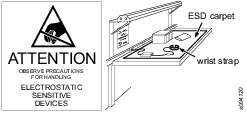
The components inside the tool and controller are sensitive to electrostatic discharge. To avoid future malfunction, make sure that service and maintenance is carried out in an ESD approved work environment. The figure below shows an example of an appropriate service work station.
Maintenance instructions
Overhaul
Service must only be carried out by qualified personnel who have access to the Service instruction and/or have been trained for service on Tensor tools.
The electric motor is a sealed unit and may under no circumstances be opened by anyone else than Atlas Copco Industrial Technique AB!
If you decide that the electric motor is defect or in need of service, return the complete motor unit to Atlas Copco Industrial Technique for replacement.
Motors which have been opened by anyone else than Atlas Copco Industrial Technique will not be serviced.
Overhaul and preventive maintenance is recommended at regular intervals once per year or after maximum 250.000 tightening depending on which occurs sooner. More frequent overhaul may be needed if the machine is used in heavy-duty operations. If the machine not is working properly, it should immediately be taken away for inspection.
When dismantling the tool always use the specially designed service tool 4080 0848 80, (two service tools are required).
Service recommendations
Preventive maintenance is recommended at regular intervals. See the detailed information on preventive maintenance. If the product is not working properly, take it out of service and inspect it.
If no detailed information about preventive maintenance is included, follow these general guidelines:
-
Clean appropriate parts accurately
-
Replace any defective or worn parts
Service instructions
Overhaul and preventive maintenance is recommended at regular intervals once per year or after maximum 250.000 tightening depending on which occurs sooner. More frequent overhaul may be needed if used at high torque, high cycle rate or long tightening times. If the machine is not working properly, it should immediately be taken away for inspection.
At the overhauls, all parts should be cleaned accurately and defective or worn parts (i.e. O-rings) should be replaced.
Lubrication instructions
Lubricating guide
Brand | Cable nut | Gears |
|---|---|---|
Molycote |
| BR2 Plus |
CRC | Litium grease No. 3020 |
|
Brand | Angle gears | General purpose |
|---|---|---|
Molycote | Longterm 2 plus |
|
Almagard |
| LE 3751 |
Lubrication
Planetary gears, needle bearings and ball bearings must be lubricated with soft grease containing molybdenumdisulphide at the regular overhaul of the tool.
Repair instructions
Repair
Repair must only be carried out by qualified authorised personnel. For further information contact your local Atlas Copco sales representative.
Troubleshooting
Power Focus 600/6000
Is the unit switched on? Check the earth fault circuit breaker behind the front door. Should it have tripped, make sure to find the primary fault before resuming operation. Check that the wiring on the remote start connector is correct. For further information see 9836 4954/9836 7446.
Power Focus 3000/4000
Is the POWER FOCUS switched on and in RUN mode? Check that the correct POWER FOCUS is used (ST31/ST32/ST61/STR31/STR61-Tensor3-7, ST81-Tensor8-9). Check the fuses for the drive part. Check Drive parameters, refer to the User Guide of the POWER FOCUS/ drive unit. Check the earth fault circuit breaker on the backside of the drive. Should it have tripped, make sure to find the primary fault before resuming operation. Check that the wiring on the remote start connector is correct. For further information see 9836 2258.
If the tool becomes very hot
With proper adjustment the tool can handle any normal line jobs that an operator sustains. What can cause overheating are combinations of some factors: torque above rated, too low speed, too long ramp time (motor has to give high torque for a long time), very high prevailing torque, very soft joints, short cycle time. To correct, look over speed, ramp time, tightening strategy. One stage and Ergoramp are most heat conserving when applicable. Please refer to the User Guide of your POWER FOCUS. If the above corrections are not enough, choose a tool of the next higher capacity.
Recycling
Recycling instruction
When a product has served its purpose it has to be recycled properly. Dismantle the product and recycle the components in accordance with local legislation.
Recycling information Tensor ST101
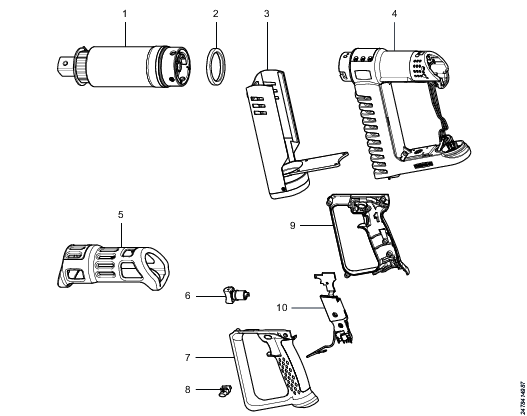
Part | Remarks | Recycle as | |
1 | Gear unit |
| Metal, Steel |
2 | Spacer |
| Plastics, Other, POM |
3 | Fan, complete |
| Electronic |
4 | Motor casing |
| Electronic |
5 | Protective cover |
| Plastics, PP |
6 | Trigger button |
| Metal, Steel |
7 | Handle |
| Plastics, Other, PA |
8 | Reverse button |
| Metal, Brass |
9 | Handle |
| Plastics, Other, PA |
10 | Main card |
| Electronic |